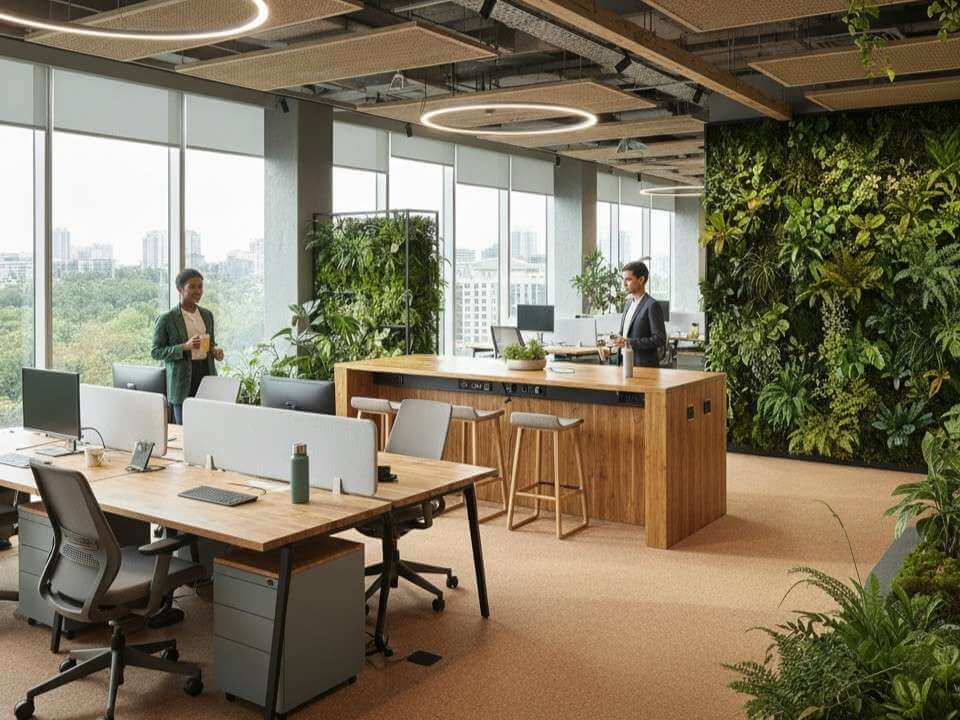
Sustainable office design & fit outs in Dubai are fast becoming a defining feature of forward-thinking workplaces. As environmental benchmarks shift from aspiration to expectation, the companies who choose sustainable workplaces are quietly gaining more than just green credentials: They’re building workspaces that are leaner, smarter, and better attuned to what both employees and stakeholders value most.
From modular reuse and digital energy tracking to wellness-driven layouts, this article explores seven key trends transforming the way offices are fitted out. Whether you’re planning a new space or upgrading an existing one, these insights offer a practical lens into the next chapter of workplace sustainability.
In 2025, sustainable fit out Dubai projects are being shaped not only by government initiatives like the UAE’s Net Zero 2050 strategy, but by a growing recognition that healthier, more efficient environments deliver tangible returns in performance, in wellbeing, and in brand perception. More than a design upgrade; sustainable workplaces are in fact strategic decisions with lasting impact.
Trend no 1 - Low-VOC and Non-Toxic Materials
Poor indoor air quality is linked to headaches, fatigue, and long-term illness. In office environments, it also directly impacts cognitive performance and absenteeism — concerns addressed by WELL and LEED standards. In response, interior fit out contractors in Dubai are moving away from traditional finishes toward low-toxicity alternatives.
Here’s how sustainable office fit outs are prioritising health through material usage:
- VOC-compliant finishes: Interior fit out contractors in Dubai are selecting paints, adhesives, and sealants with VOC content below 50g/L, supported by certifications like GREENGUARD Gold or Red List-free declarations.
- Health-focused furniture: Workstations and partitions are now evaluated for their emission profiles, with a preference for recycled content, formaldehyde-free composites, and low-toxicity textiles — balancing sustainability with ergonomics and overall user wellbeing.
- Air testing and monitoring: Indoor air quality audits, conducted before and after occupancy, are being embedded into project close-out processes — ensuring measurable compliance with LEED standards.
- Transparent procurement: Leading fit out companies are insisting on transparent declarations from suppliers and rejecting non-compliant products, especially in high-contact or enclosed environments.
How it’s being applied in real-life fit outs:
In practice, interior fit out contractors in Dubai are implementing more rigorous supplier screening and materials tracking to meet evolving sustainability standards. USBC Interiors, for example, conducts full vendor vetting ensuring that all suppliers meet ethical, environmental, and wellness-focused benchmarks. This supports the delivery of low-VOC, health-conscious interior solutions aligned with LEED certification targets.
Trend no 2 - Net-Zero Carbon Fit Outs
With the UAE’s Net Zero by 2050 strategy influencing both regulation and investment, commercial interiors are under growing pressure to demonstrate climate responsibility. Sustainable office fit outs in Dubai are no longer focused solely on operational efficiency — they must now address the environmental impact of materials and construction from the outset. For forward-thinking organisations, this shift offers an opportunity to lead in transparency, innovation, and long-term value.
Here’s how this trend shapes sustainable office fit outs:
- Lifecycle carbon modelling: Tools like BIM and Mastt are used early in the process to measure the total footprint of fit outs — covering sourcing, transportation, and installation. This enables better decisions before a single material is ordered.
- Smart MEP integration: Mechanical, electrical, and plumbing (MEP) systems are now optimised through automation. Zoned HVAC, daylight-responsive lighting, and energy metering allow for real-time energy reduction while maintaining user comfort.
- Passive design strategies: Layouts are being adapted to reduce artificial cooling and lighting demand. Features like natural ventilation, solar shading, and efficient insulation are now being integrated into fit out planning — particularly in glass-heavy commercial buildings.
- Material selection with intent: Choosing lower-impact materials — such as FSC-certified timber or modular aluminium systems — helps reduce embodied emissions and often supports LEED point achievement. More on this later.
Trend no 3 - Biophilic Design for Healthier Workspaces
Biophilic design in office fit outs integrates natural elements into indoor spaces — from daylight and greenery to natural textures, sounds and materials. As evidence grows around the connection between our indoor environments and its effect on both physical and mental health, biophilic strategies are now widely recognised for reducing stress, enhancing cognitive function, and improving overall wellbeing. In turn, this translates to healthier, more present employees and measurable business benefits through improved productivity, engagement, and reduced absenteeism.
How it’s shaping sustainable office fit out Dubai projects:
Green infrastructure in interiors: Indoor planting schemes, moss walls, and vertical gardens are now integrated into reception zones, breakouts, and circulation spaces. These are designed not just for aesthetics, but for improved air quality and acoustic absorption.
Daylight optimisation: Daylighting is now a design priority. Fit out contractors in Dubai are repositioning floorplans to maximise window access and using transparent partitions to distribute natural light deeper into open-plan areas. This reduces artificial lighting demand and regulates circadian rhythm — a WELL Building Standard requirement.
Natural materials and finishes: Timber, cork, stone, and textured surfaces are being chosen for their tactile qualities and biophilic resonance. These materials also support sustainable fit out Dubai targets by offering low-VOC, recyclable options aligned with LEED and WELL benchmarks.
Outdoor connectivity: Where space allows, office fit outs are increasingly incorporating terraces, shaded courtyards, and rooftop zones with Wi-Fi and seating — creating a psychological reset zone that encourages healthy breaks.
Where sustainable fit out Dubai projects are applying biophilic principles:
USBC Interiors has implemented WELL-compliant biophilic elements in commercial interiors such as Dubai Hills Park Office and Etihad Rail Office — applying daylight studies, plant integration, and renewable surface choices to support employee wellbeing while also meeting ESG goals.
Trend no 4 - Smart Technology for Sustainable Workplaces
Digital tools are becoming the backbone of sustainability in office interiors — offering real-time data, automation, and user control that supports both efficiency and comfort. As ESG performance becomes a C-suite priority, smart systems allow sustainable workplaces to be optimised long after handover.
Let’s look at how sustainable fit out projects are integrating smart technology:
- Sensor-integrated HVAC and lighting: IoT-enabled systems respond to real-time occupancy and daylight levels, adjusting airflow and brightness automatically to reduce waste.
- Digital twin integration: Advanced fit outs use digital replicas to simulate system performance, optimise layout strategies, and forecast maintenance — improving both sustainability and cost predictability.
- Smart booking tools: Sensor-driven meeting room and desk booking platforms help reduce space wastage, enabling businesses to optimise layout and energy use.
- User-controlled comfort systems: Touch-free systems and app-based controls allow occupants to adjust temperature, lighting, and ventilation preferences, increasing satisfaction while supporting energy goals.
What smart technology integration looks like inside Dubai’s office fit outs:
Commercial fit out solutions in Dubai are using integrated smart tech to reduce consumption and elevate occupant experience while aligning with government initiatives. This includes motion sensors, IoT-enabled HVAC, and predictive building analytics ensuring sustainable office fit out projects meet performance targets long after handover.
Trend no 5 - Water and Energy Efficiency in Office Fit Outs
In line with the resource-efficiency goals discussed in circular and smart technology trends, energy and water savings have emerged as high-impact, low-barrier strategies — offering measurable ROI alongside regulatory compliance.
How the trend is shaping sustainable office fit outs:
- Zoned HVAC and smart metering: Interior fit out contractors in Dubai are zoning mechanical systems by usage type — reducing unnecessary air conditioning in underused zones and leveraging real-time metering to flag inefficiencies.
- Low-flow and greywater plumbing: Water-saving fixtures such as aerated taps and dual-flush toilets are paired with reuse systems that divert greywater to landscaping or cooling — now common in sustainable fit out Dubai projects.
- LED and daylight-responsive lighting: Efficient lighting design, combined with controls that dim or switch off based on occupancy and daylight levels, offers quick ROI and supports certification goals.
- Appliance and system efficiency: From ENERGY STAR-certified fridges to efficient data room cooling, resource consumption is tracked and reduced at every layer.
Final Thoughts
The sustainable office design trends emerging in 2025 demonstrate a fundamental shift where environmental responsibility and human well-being are inseparable from business strategy. By integrating biophilic design, prioritizing circularity in materials, leveraging smart technology for efficiency, and building adaptable, energy-conscious spaces, companies are not just achieving a smaller carbon footprint, they are strategically investing in a more productive, healthier, and resilient workforce. The future workplace is defined by a holistic approach, where the design choices we make today create enduring value for both the planet and the people within the organization.
FAQs
Sustainable office design helps reduce environmental impact, lowers operational costs, and creates healthier workplaces that boost employee productivity and well-being. It’s also becoming a key factor for businesses aiming to meet ESG goals and attract eco-conscious clients
Simple steps like using LED lighting, integrating natural ventilation, choosing recycled or locally sourced materials, and installing smart energy systems can make a big difference without major renovation costs.
Companies can work with local fit-out specialists experienced in green building standards such as LEED or WELL. Using modular furniture, energy-efficient HVAC systems, and water-saving fixtures are great starting points for sustainable offices in Dubai’s climate.